
Why General-Purpose Workstations Fail in Cleanrooms: What GMP Manufacturing Demands of a Mobile Cart

A general-purpose workstation tends to arrive in a cleanroom for reasons that all sound sensible at the time. There is an office-grade cart or an industrial mobile stand available, it takes a standard PC and monitor, it costs a fraction of purpose-built equipment, and on the day it is wheeled in it does everything asked of it. Operators reach MES and SOPs at the point of work, the screen is bright, the wheels roll, the workflow case is made, and for the first few weeks nothing about the decision looks wrong.
The trouble tends to start a few months in. The cleaning and disinfection regime that holds the space at a controlled particle and microbial level begins to show on the cart: coatings chip, fasteners corrode, and residue collects in places that are difficult to clean, until the cart reaches a condition a quality team cannot sign off.
The cause sits in the specification. The workstation was built from materials, and with a geometry, suited to a different room, and a cleanroom does one thing relentlessly: it cleans itself, with agents chosen to destroy micro-organisms, applied to every surface on a regular schedule.

The Cleanroom's Job Is to Be Cleaned
Everything inside a GMP cleanroom falls under a cleaning and disinfection programme, and equipment is included. The 2022 revision of EU GMP Annex 1, in force since August 2023, is explicit on the point: materials used in cleanrooms, both in the construction of the room and for items used within it, should be selected to minimise the generation of particles and to permit the repeated application of cleaning, disinfectant and sporicidal agents where used (clause 4.7).
Those agents are among the more aggressive chemistries in routine industrial use. Sporicidal rotations in pharmaceutical cleanrooms commonly use sodium hypochlorite, peracetic acid or hydrogen peroxide, chosen because they destroy bacterial spores, and every surface in the room has to absorb the same treatment on the same schedule for years. General-purpose equipment is specified for an occasional wipe-down with a mild cleaner, and the gap between that duty cycle and a standing sporicide rotation is why one survives the cleanroom and the other does not.
Surfaces Are the First Thing to Go
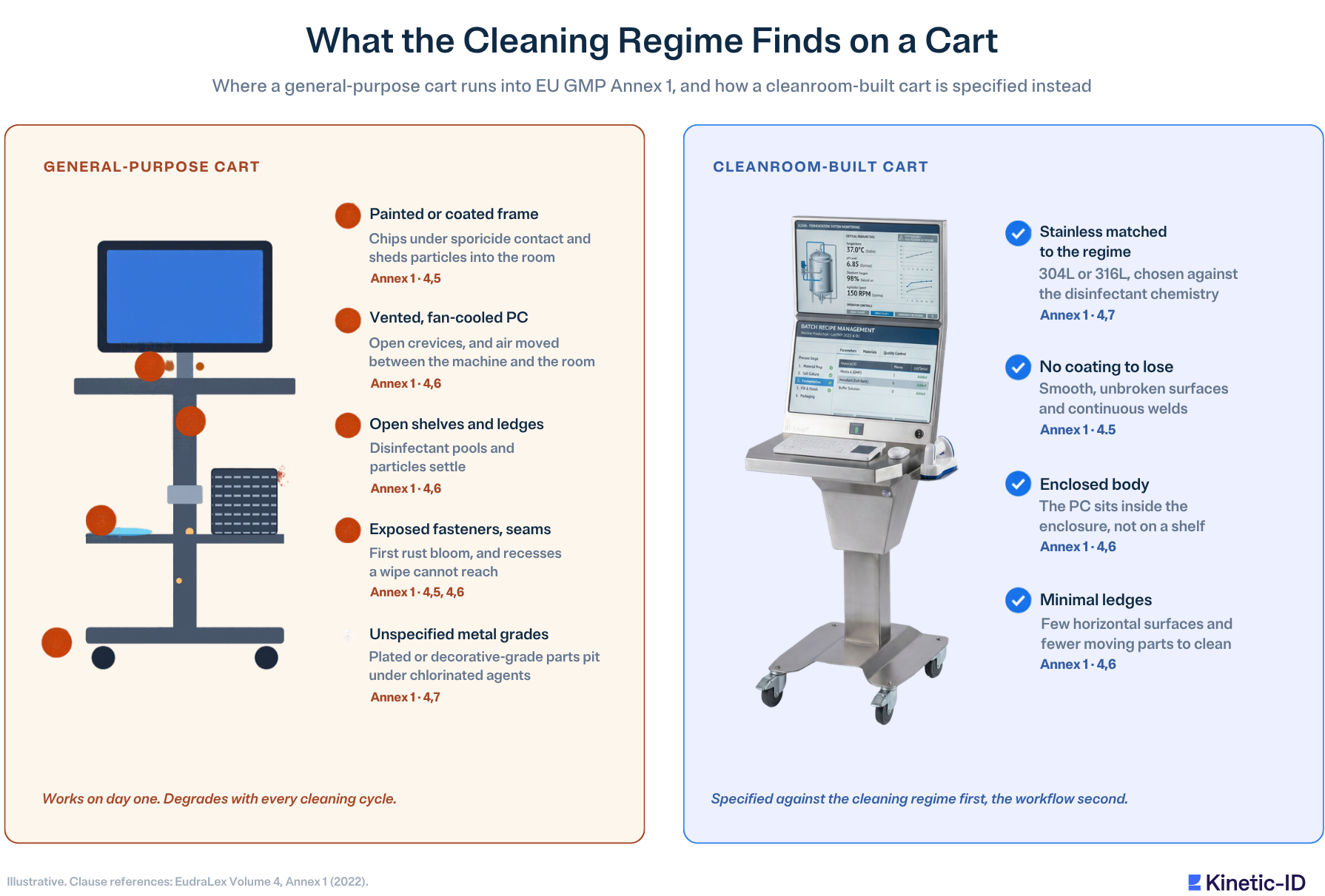
Annex 1 sets a plain requirement for the surfaces themselves: all exposed surfaces should be smooth, impervious and unbroken in order to minimise the shedding or accumulation of particles or micro-organisms (clause 4.5). A general-purpose workstation rarely meets that requirement for long once the cleaning regime gets to work on it.
Painted and powder-coated steel frames are the most common problem. On those frames the coating is the surface, and under repeated sporicide contact and daily wiping it chips and flakes, at which point the frame is shedding particulate into a controlled space. Other materials common in general-purpose equipment bring their own problems: galvanised steel and wood are routinely excluded from cleanrooms altogether, and some plastics outgas or present porous, hard-to-clean surfaces. None of these behaviours fits a standard whose first requirement of a surface is that it stays smooth, impervious and unbroken.
Corrosion Becomes a Place Contamination Lives In
The most consequential failure is corrosion, because of what corrosion becomes in a GMP environment. Sodium hypochlorite is corrosive to some metals and leaves a particulate residue, and where it runs frequently, chloride attack shows up on steel as pitting. A pit is a break in a surface Annex 1 expects to be unbroken, and it is a small, sheltered recess that a wipe cannot reach, where micro-organisms can persist through the cleaning that was meant to remove them. The residue adds to the problem, which is why cleaning programmes that rely on hypochlorite include a residue removal step.
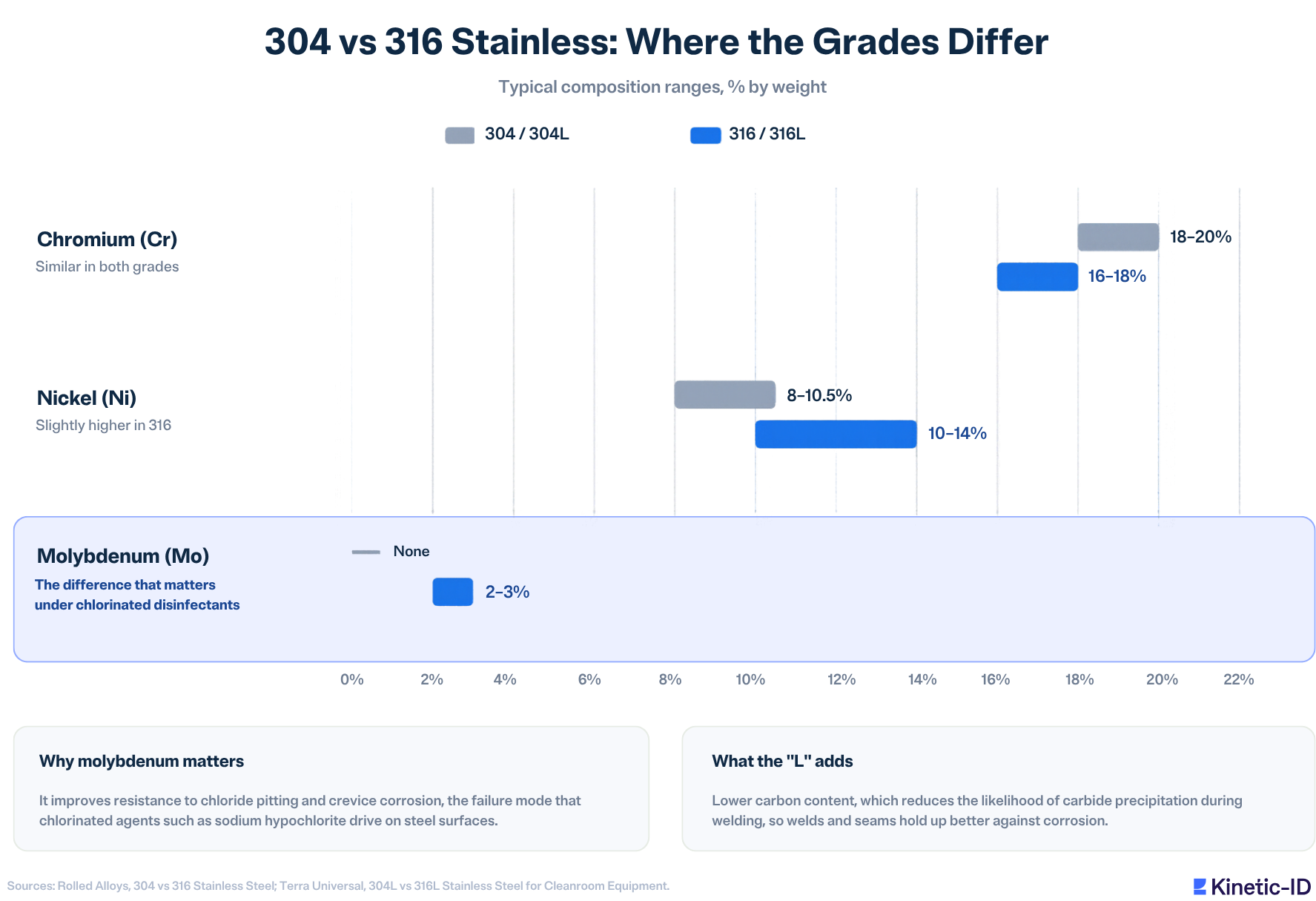
This is also where the assumption that “stainless is stainless” costs sites the most. 316 and 316L stainless steel contain roughly 2 to 3 percent molybdenum, while 304 and 304L contain none, and that molybdenum is what improves resistance to chloride pitting and crevice corrosion, the failure mode a hypochlorite rotation drives. Terra Universal recommends 316L for pharmaceutical and laboratory settings with frequent harsh cleaning, including bleach-based disinfectants. Choosing a grade means matching the steel to the room's grade and its disinfectant chemistry, which is why a well-specified cart states its grade. The larger risk sits with carts whose metal grade was never specified at all: plated parts, mixed metals, or a decorative stainless selected for appearance and cost.
The low-carbon “L” grades matter too. Lower carbon reduces the likelihood of carbide precipitation during welding, and welds and seams are where corrosion on a fabricated cart tends to start.
Every Recess, Vent and Moving Part Becomes Something to Clean
Annex 1 also addresses geometry. To reduce the accumulation of dust and to make cleaning effective, there should be no recesses that are difficult to clean, and projecting ledges, shelves, cupboards and equipment should be kept to a minimum (clause 4.6).
A consumer or industrial PC is usually air-cooled, with vents and a fan that draw air across internal components and expel it, which creates unsealed internal crevices and moves air between the machine's interior and the controlled space. Standard enclosures add seams, exposed fasteners and cable runs, while exposed height-adjustment mechanisms and open shelving add moving parts and horizontal ledges where disinfectant pools and particles settle. Each of those features collects contamination and resists validated cleaning, which is the geometry clause 4.6 is written to keep out, and a workstation designed for a cleanroom removes them deliberately.
What the cleaning regime does to a general-purpose workstation
What It Looks Like in Practice
Take a Grade C support area feeding a filling line, where a general-purpose cart carries the MES terminal to the point of work. On day one it performs as hoped. Over the following months of daily disinfectant wipe-downs and periodic sporicide rounds, the picture changes: the painted frame chips at the handle and around the base, the fasteners on the monitor mount show the first rust bloom, and a pit forms on a horizontal ledge where disinfectant collected and sat.
At that point the workstation is a deviation waiting to be written, a gap in cleaning validation, and a capital replacement pulled years forward. A stainless cart specified for that room, with an enclosed body and no ledge for disinfectant to sit on, would have taken the same regime without becoming a finding.
For Operations and Engineering Teams, the Question Is Specification
For the teams who own this decision, the useful test is whether a workstation has been specified against the room it will live in. A short set of questions separates a cleanroom-grade cart from an adapted one before it reaches the airlock:
- What grade is the stainless (304, 304L or 316L), and does it match the disinfectant chemistry the room runs?
- Can every external surface take repeated cleaning and sporicide treatment without coating loss, and are the welds smooth and unbroken?
- Where does the computer sit, and is it enclosed against the cleaning regime?
- How many ledges, recesses and moving parts does the design carry, and can each be cleaned to the validated standard?
- What material and chemical compatibility documentation does the supplier provide to support the site's cleaning and disinfection programme?
Put a number on the wrong cart before you specify the right one
The cost of a general-purpose cart tends to show up later, as a replacement pulled forward when the frame corrodes and the disruption while a cart comes off the line. Kinetic-ID's ROI calculator models cart cost, unit life and maintenance alongside operator walking time, batch record review and deviations, so the purchase price can be weighed against what a cleanroom cart returns over its life.
Open the ROI calculator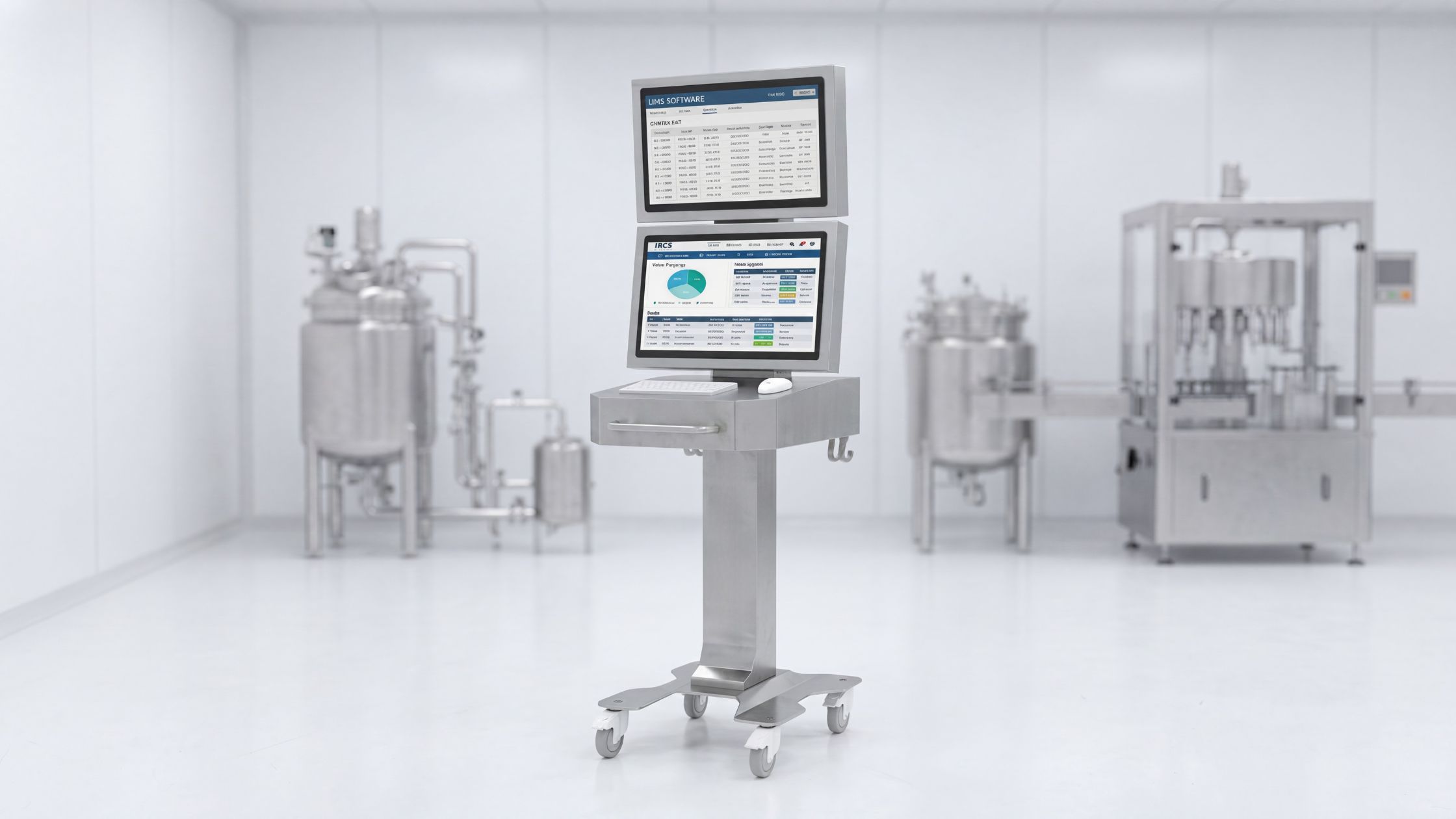
What a Purpose-Built Cleanroom Cart Changes
A cart built for a cleanroom is specified against the cleaning regime first and the workflow second, which reverses the order in which a general-purpose choice gets made. Kinetic-ID's Life Sciences workstations are built on that principle.
The ID-Flow range uses fully enclosed stainless steel construction, with the grade matched to the environment. The ID-Flow 5 is a 304L mobile workstation rated for Grades A to D, with hot-swappable batteries for continuous operation, and the ID-Flow 6 encloses the whole unit, monitors included, in 304L stainless for Grade C and above. For Grade B and high-compliance areas, the ID-Flow 9 moves to 316L, with a fixed-height design that has no moving parts or electronic lift mechanisms. Where a fixed screen suits the workflow better than a mobile one, the ID-View wall-mounted HMI, available in 304L or 316L, brings the same approach to Grade C and D rooms.
That keeps the visibility at the point of work that justified putting a workstation on the floor in the first place, without the liability a general-purpose cart builds up every time the room is cleaned.
The Difference Is Decided at Specification
A general-purpose workstation fails in a cleanroom because of what it was specified for. The cleanroom's defining activity is being cleaned, over and over, with agents built to destroy micro-organisms, and that is the one duty cycle the workstation was never designed to withstand. The corrosion, the shedding and the residue in the recesses all trace back to a material and a geometry chosen for a different room.
A cart built for that regime keeps a workstation at the point of work without turning into the surface the cleaning was meant to protect, and that outcome is settled at specification, long before the cart reaches the airlock.
If your cleanroom mobile carts weren't specified against your cleaning regime, here's what we build
Kinetic-ID builds GMP-rated mobile and fixed workstations in 304L and 316L stainless steel for pharmaceutical, biotech and MedTech manufacturing. Our solutions team can walk you through the grade requirements, material options and configurations for your environment.
Speak with a solutions consultant
Frequently Asked Questions
References
- European Commission. EudraLex Volume 4, Annex 1: Manufacture of Sterile Medicinal Products (published August 2022, in force 25 August 2023). https://health.ec.europa.eu/system/files/2022-08/20220825_gmp-an1_en_0.pdf
- Rolled Alloys. 304 vs 316 Stainless Steel: Corrosion Resistance, Properties, and Applications. https://www.rolledalloys.com/articles/304-vs-316-stainless-steel-corrosion-resistance-properties-applications/
- Terra Universal. 304L vs. 316L Stainless Steel for Cleanroom Equipment. https://www.terrauniversal.com/blog/304L-vs-316L-cleanroom-stainless-steel-differences-advantages-benefits
- Rossington, K. (Contec Inc.). Busting the Myths of Chlorine Disinfection. European Pharmaceutical Manufacturer. https://emea.contecinc.com/hubfs/Resources/EMEA%20-%20Articles,%20White%20Papers/Chlorine%20disinfection.pdf
- TechSafety. Acceptable Cleanroom Materials. https://techsafety.com/blog/acceptable-cleanroom-materials
