
When Your Medication Cart Dies Mid-Round: Battery Management and Business Continuity in NHS Hospitals

6:15am, and Two of the Four Carts Won't Turn On
Picture a Monday morning on a medical ward. The early drug round starts in fifteen minutes and the night team is handing over. A nurse walks to the treatment room, presses the power button on the medication cart and nothing happens, and when she tries the second cart it is dead too. Nobody checked the batteries over the weekend, because nobody knew they needed checking, and there was no system, alert or dashboard to say that Cart 3 was at 11% and wouldn't last the round.
So the ward shares carts, one between two nurses, and the round takes far longer than it should. Patients waiting for time-critical medicines, such as levodopa for Parkinson's disease or insulin for diabetes, risk missing their window, while the ward manager spends the start of the shift on the phone trying to get a replacement sent up from another floor.
Some version of that morning is familiar on many wards, and it happens because cart batteries tend to be managed reactively: nothing is checked until something stops working.

Why Battery Visibility Matters More Than It Seems
A medication cart isn't optional equipment. It is how medicines reach patients during a round, so if the cart doesn't work, the round doesn't happen on time, and for some medicines timing is part of the treatment.
NICE guidance on Parkinson's disease (NG71) says that people admitted to hospital should have their medicines given at the appropriate times, and the related quality standard measures levodopa doses given more than 30 minutes from the individually prescribed time. Parkinson's UK's Get It On Time campaign exists because over half of people with Parkinson's don't get their medication on time in hospital, and its Every Minute Counts report found that only 42% of people admitted to hospitals in England got it on time every time, a finding that has since led to an NHS England programme. The NHS Specialist Pharmacy Service lists insulin and Parkinson's medicines among its examples of time-critical medicines, and its Safer Use of Time Critical Medicines Programme, part of NHS England's Medicines Safety Improvement Programme, works to reduce delayed and omitted doses.
A flat cart battery rarely appears in an incident report as the cause of a late dose, but it can be one. CQC Regulation 12 requires “the proper and safe management of medicines”, and when a trust is asked how it makes sure drug rounds run on time, the equipment the round depends on is part of the answer. If nobody can see whether the carts are charged, a trust is relying on them being charged rather than knowing it, which is a weak place for a continuity plan to start.
What Most Hospitals Do Today
The usual approach to cart batteries is to buy powered carts, ask staff to plug them in at the end of each shift and rely on that happening. Beyond that there is rarely any monitoring, alerting or fleet-level view of which carts are charged, which batteries are wearing out and which are close to failing.
That is unusual by the standards of hospital IT. Laptops, desktops, phones, printers and networked infusion pumps can all be seen and managed remotely, with their status on a dashboard and issues flagged centrally, while a conventional medication cart sits on the ward unconnected, producing no data, until someone finds it won't turn on.
Some wards keep a paper log of when carts were plugged in, but a log can't show that a battery now holds far less charge than it did six months ago, or that Cart 7 on Ward 12 has been unplugged for three days because someone moved it to the corridor. We looked at this visibility gap in What Should Your Medication Carts Tell You?, and for most trusts the answer is not nearly enough.
What Remote Battery Monitoring Looks Like
Remote monitoring for medication carts works much as it does for any fleet of powered devices. A low-power transmitter on the cart sends data to a gateway, which feeds a central dashboard. LoRaWAN is one technology suited to this, a long-range, low-power wireless standard designed for deep indoor coverage, which matters in hospital buildings where signals have to pass through concrete walls and between floors.
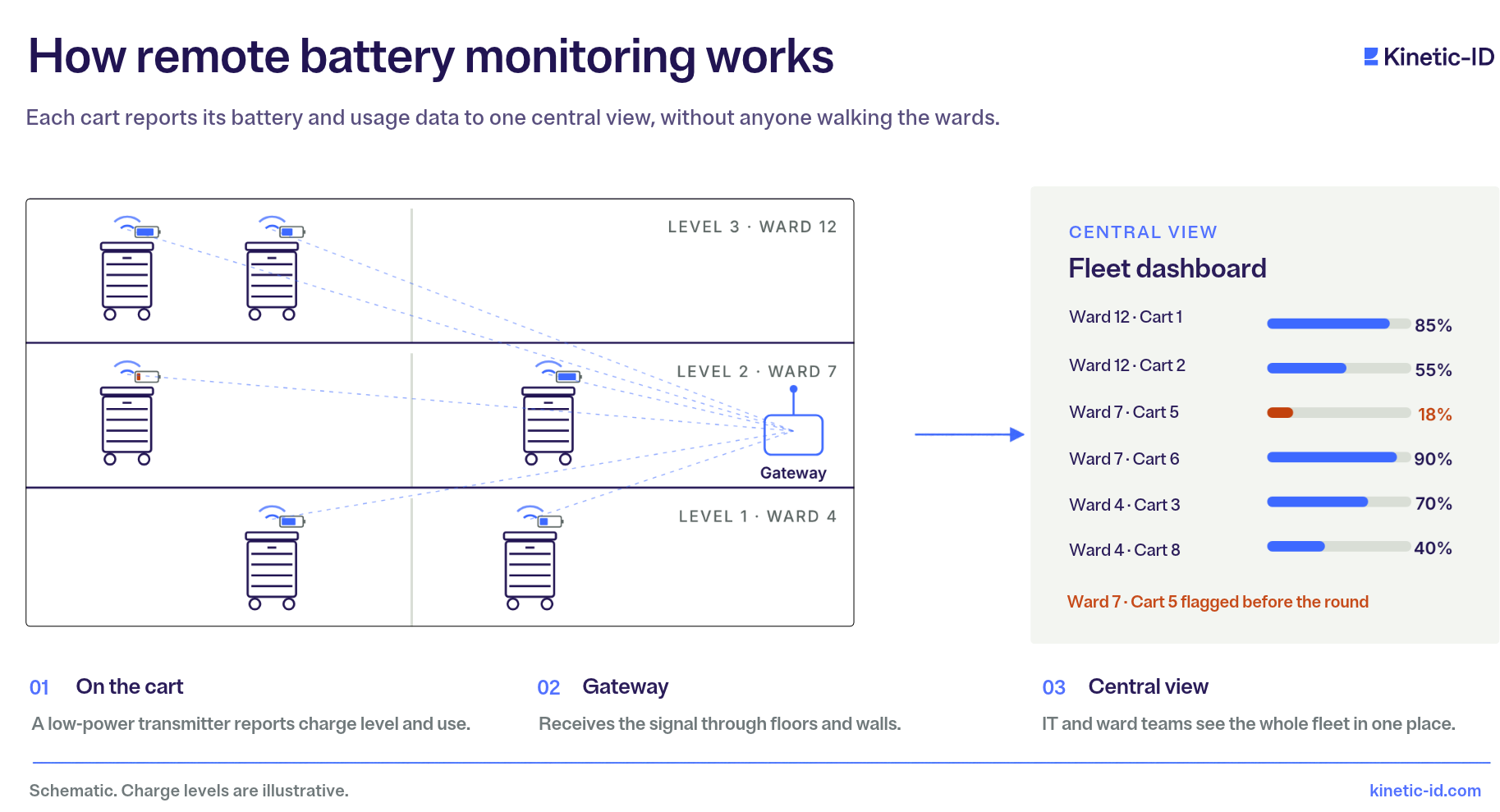
A fleet view shows three things. The first is charge level per cart, the percentage the battery is at right now, so that if Cart 5 is at 18% at 5am someone can act before the morning round. The second is how battery health changes over time, so that a cart which used to run for 14 hours on a charge and now runs for 8 is caught as a maintenance job before it becomes a patient safety issue. The third is usage, which carts work hard and which sit idle, and that says something about ward workflows, staffing and whether the fleet is the right size.
Kinetic Pulse is Kinetic-ID's remote monitoring for this. On Med-Safe it reports battery status and frequency of use to the central dashboard, so IT can see the state of the cart estate without walking to a single ward. For how battery technology choices affect long-term cost, see The Hidden Costs and Risks of Hot-Swappable Batteries in Healthcare Workstations.
Where Carts Fit in Business Continuity Planning
Most NHS trusts have business continuity plans for IT systems, power outages and staff shortages, but medication carts are rarely named in them. It is a fair question to ask: if a trust has 40 powered medication carts across 15 wards, what happens when five fail on the same day? Are there spares, where are they kept, who manages the rotation, and how quickly can a replacement reach a ward that has already started its round?
Without visibility none of those questions has a reliable answer, so the trust reacts to failures instead of preventing them, and each failure is a round that runs late. Pharmacy feels it too, because late rounds have knock-on effects for dispensing schedules, discharge medication and TTO (to take out) preparation, so a battery failure on Ward 6 at 6am can still be causing delays in pharmacy at 10am. That is part of the wider challenge of the last mile of medication, from pharmacy to patient, and a dead cart is one more gap in that chain.
What This Means for Procurement and Capital Planning
When a trust budgets for medication carts, the conversation usually centres on unit cost and drawer configuration, and battery lifecycle rarely comes up, though it should. A cart whose battery needs replacing within a year or two costs more over its life than one designed to last five, once replacement batteries, downtime and the hidden cost of delayed rounds are counted.
Remote monitoring changes that conversation, because the trust is buying carts it can manage as well as carts it hopes will last. Battery replacements can be forecast, utilisation can be shown when the case for more carts is made, and the finance team sees data rather than anecdote when the next capital bid comes round.
Paired with named access and individual authentication, battery monitoring turns a set of carts into a managed fleet, which is how intelligent access changes the drug cart conversation at procurement level. The governance side of that change is covered in From Shared PINs to Named Access, and the full product overview is in Med-Safe: Smarter Drug Rounds, Safer Storage.
If you can't see your medication carts' batteries until one fails, here's how we help
Med-Safe is Kinetic-ID's medication cart for NHS wards, with battery status and frequency of use reported through Kinetic Pulse to a central dashboard alongside each cart's access and audit data. IT can see the state of the fleet without walking the wards, and ward teams can deal with a low cart before the round starts. Our solutions team can walk IT, pharmacy and nursing through how monitoring would work across your fleet.
Speak with a solutions consultant →
Frequently Asked Questions
Related reading
- What Should Your Medication Carts Tell You?
- Med-Safe: Smarter Drug Rounds, Safer Storage
- The Last Mile of Medication: From Pharmacy to Patient
- The Hidden Costs and Risks of Hot-Swappable Batteries in Healthcare Workstations
- From Shared PINs to Named Access
- How Intelligent Access Changes the Drug Cart Conversation
References and sources
1. NICE Guideline NG71: Parkinson's disease in adults. Section on levodopa timing and medication management in hospital settings.
2. Parkinson's UK, "Get It On Time" campaign. Evidence on medication timing failures in NHS hospitals and the clinical impact of delayed levodopa administration.
3. CQC Regulation 12: Safe care and treatment. Includes requirements for timely administration of medicines.
4. NHS England, Medicines Safety Improvement Programme. Guidance on medication-related patient safety incidents.
5. LoRa Alliance, LoRaWAN specification. Technical overview of long-range, low-power wireless protocol used in healthcare IoT applications.
See what your cart fleet looks like from a dashboard
If you manage powered medication carts or workstations across multiple wards, Kinetic Pulse gives you the visibility you're missing. Battery health, charge trends, and usage data, without walking to a single ward.
Book a 20-minute walkthrough with our solutions team.
