
What Happens to the 8-to-1 Ratio When Wards Go Single Room?

The NHS is building a different kind of ward. The staffing model hasn't caught up yet.
Walk into an old Nightingale ward and the layout tells you something. Eight beds in a row. One nurse at the centre. A glance in either direction covers every patient in seconds.
That geometry has shaped how nursing works for generations. A nurse can visually assess a patient, at minimum for their level of comfort. Without walking a step.
The NHS is changing its approach to patient rooms for new build hospitals. Single-room wards are coming, and they're coming fast.
The reasons are sound: patient privacy, dignity, better infection control, fewer mixed-sex accommodation breaches. The NHS 10 Year Plan is clear that the shift to single rooms is part of building a health service fit for the 21st century. New hospital builds are targeting at least 50% single rooms, and several are going to 100%.
But there is a real and documented consequence that doesn't get enough attention. When you remove the open ward, you remove the visibility. And when you remove the visibility, there will possibly be affects on the nurse-to-patient ratio.

The 8-to-1 ratio and what it actually rests on
The Royal College of Nursing's position, published in May 2025 is measured but clear. There is no single staffing ratio that applies across all acute inpatient wards. But the evidence points consistently in one direction: increased risk of harm when one registered nurse is responsible for more than eight patients.
Having more registered nurses on hospital wards is causally linked to reduced mortality. A recent review of the evidence found there is little room for doubt.
That link between nurse numbers and patient outcomes has been debated for years. The RCN's position draws on a growing body of longitudinal research that now goes well beyond correlation. Higher registered nurse staffing reduces mortality. That is, at this point, settled.
The 8-to-1 figure is a ceiling, not a target. It describes the point at which risk begins to rise, not the optimal state. Most clinical teams understand this. The challenge is that even reaching that ceiling is getting harder as wards reconfigure and NHS trusts face ongoing financial pressure.
What single rooms do to nursing workload
Peer-reviewed research on single-room wards is clear on one thing above all else: nurses felt unprepared for the change in how they work.
A mixed-methods evaluation published in BMJ Quality and Safety followed NHS staff through a move to 100% single-room accommodation. The findings were specific. Nurses reported that their ability to monitor patients was impeded. Walking distances increased. The informal, peripheral awareness that comes from working in an open environment, noticing a patient's restlessness, hearing a change in breathing, seeing that someone hasn't touched their food, disappeared almost entirely.
Only 18% of staff preferred 100% single room wards. Most were concerned that their ability to monitor patients was impeded and that they felt isolated from their colleagues.
A 2023 integrative review in the Journal of Clinical Nursing confirmed this pattern across multiple studies. Single rooms increased walking distances, affected job satisfaction, and made it harder for nurses to maintain the kind of ambient awareness that open wards naturally provided. The care didn't stop. But the effort required to deliver the same standard of monitoring went up significantly.
The Royal College of Nursing's own guidance acknowledges this directly. Several authors have suggested the potential need for increased staffing levels as a result of more single rooms, or at minimum, adjustments to skill mix.
The cost side of the equation
In a conversation worth sharing, the financial implication was laid out plainly. On an 8-to-1 ratio, with two shifts and a nurse salary of around £50,000, the nursing cost per patient bed works out at roughly £12,500 per year. Move to a 6-to-1 ratio to maintain the same standard of care in a single-room environment, and that figure rises to around £16,600. Across 146,000 NHS beds, the difference is over £600 million a year.
That figure isn't presented here as a criticism of single rooms. The benefits for patients are real. Two-thirds of patients in the BMJ study preferred single rooms. The move is clinically and ethically in the right direction. The point is that the staffing model needs to adapt alongside the physical environment, and that adaptation has a cost.
Technology is not a substitute for nurses. But it is part of how NHS teams can maintain safe oversight at scale, without simply adding headcounts that the NHS cannot currently afford.
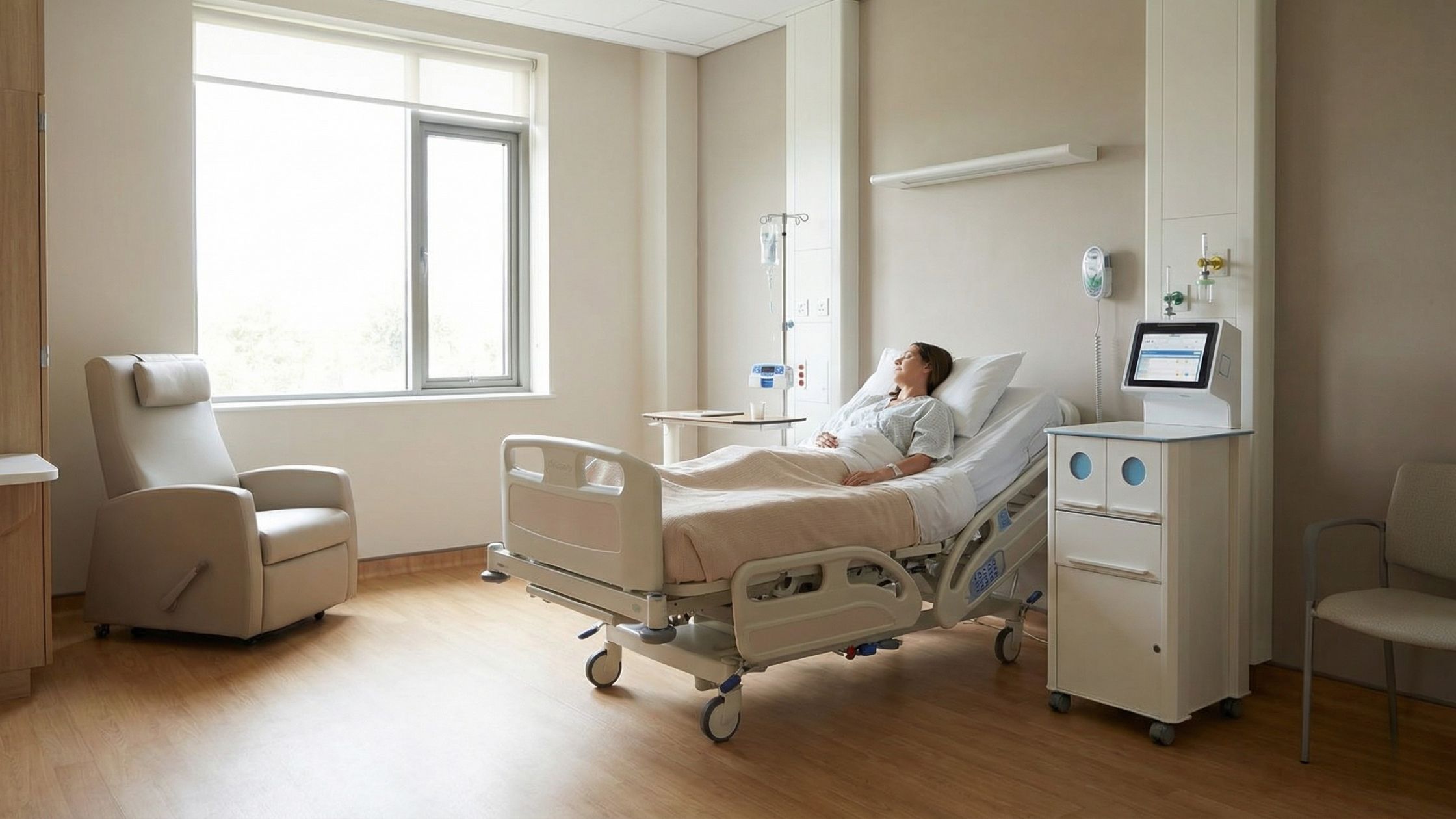
Where the visibility goes
The specific problem that single rooms create for nursing is not workload in the abstract. It is the loss of what researchers describe as peripheral perception. In an open bay, a nurse holds a continuous, low-level awareness of eight patients simultaneously. No action is required. Just presence.
In a single-room ward, that awareness disappears the moment the nurse steps out of a room. The patient behind the next door is invisible. The one three rooms down is further away than they would ever have been on a Nightingale ward. And the nurse call system, while necessary, is reactive. It tells you when a patient has already reached the point of pressing a button.
Design features of wards with single rooms and technology need to be maximised to ensure that privacy and comfort for patients does not compromise staff's ability to observe them.
That observation, from NIHR-funded research, is the clearest statement of what needs to happen. The design of single-room wards creates a problem. Technology is explicitly identified as part of the solution.
How Med-Side fits into this
Med-Side is a connected patient self-administration of medication device, and that is where its primary clinical function sits, maintaining an audit trail, connecting to EPR and EPMA systems. But the data it generates has a secondary value that matters directly to the staffing question.
When Med-Side is in a patient's room, it captures interactions. Has the patient accessed their medication at the scheduled time? Have they raised any concerns through the device? How many times has a nurse been called to that room? That data flows back to dashboards that nursing teams can view across the whole ward, from a single screen.
Data is presented to clinical teams through dashboards and alerts, supporting nursing activity across single room occupancy wards and multiple occupancy wards.
It does not replace the judgement of a nurse standing in a room. It does give nursing teams something they lose when the open ward disappears: a way to maintain a degree of awareness across multiple patients simultaneously, without physically entering each room.
Wayne Miller, Senior Solutions Consultant at Kinetic-ID, puts it directly: the product is designed to support the 8-to-1 ratio. Not solve it. The distinction matters. The evidence on staffing is clear that registered nurses cannot simply be replaced by technology or by lower-skilled staff. But within a ward where the physical layout is working against visibility, data from the bedside is not a replacement for nursing. It is a layer of support that the architecture of a single-room ward otherwise removes.
Want to see how Med-Side supports SAM in practice?
Book a demo with the Kinetic-ID team.
Schedule a demo.jpg)
The question worth asking now
NHS trusts building new wards are making decisions today about the technology infrastructure that will sit alongside the physical design. The case for thinking about bedside data alongside ward layout is not a technology sales argument. It is a patient safety one.
The research on single rooms is clear: the design is better for patients and harder for nurses. Closing that gap is partly a staffing question. It is also a question of what information nurses have access to, and how quickly.
That is where the conversation about bedside technology belongs. Not as a feature. As part of the answer to a question that the NHS is already asking.
REFERENCES
1. Ball, J. (2025). Registered nurse staffing levels for patient safety, care quality and cost effectiveness. London: Royal College of Nursing. Available at: rcn.org.uk/About-us/Our-Influencing-work/Position-statements/rcn-position-on-registered-nurse-staffing-levels-for-patient-safety
2. Maben, J., Griffiths, P., Penfold, C., Simon, M., Anderson, J.E., Robert, G., Pizzo, E., Hughes, J., Murrells, T. and Barlow, J. (2016). One size fits all? Mixed methods evaluation of the impact of 100% single-room accommodation on staff and patient experience, safety and costs. BMJ Quality and Safety, 25(4), pp.241-256. doi: 10.1136/bmjqs-2015-004265. PMC4819646.
3. Søndergaard, S.F., Thorsted, A. and Rossen, C.B. (2023). Nurses' work experiences in hospital wards with single rooms: An integrative review. Journal of Clinical Nursing, 32(17-18), pp.6459-6479. doi: 10.1111/jocn.16824.
4. Royal College of Nursing (2025). Safe Staffing: Evaluating the evidence for mandatory nurse-to-patient ratios. London: RCN. Available at: rcn.org.uk/Professional-Development/publications/rcn-safe-staffing-uk-pub-012-306. Note: the £600m+ annual cost projection uses illustrative modelling based on NHS England published bed numbers (146,000 general and acute beds) and the staffing cost differential between 8:1 and 6:1 nurse-to-patient ratios. It is presented as indicative of scale, not as a published NHS financial figure.
5. Maben, J. et al. (2015). Evaluating a major innovation in hospital design: workforce implications and impact on patient and staff experiences of all single room hospital accommodation. NIHR Journals Library, Health Services and Delivery Research, 3(3). doi: 10.3310/hsdr03030.
Designing safer medication workflows at the bedside
If your team is exploring solutions like Med-Side, Kinetic-ID can help you design a controlled self-administration setup that improves patient independence while maintaining full clinical oversight and auditability.
Speak with a solutions consultant
