
What Should Your Medication Carts Tell You? And What Do They Actually Tell You Right Now?

If your medication cart cannot tell you who opened which drawer, when, and for how long, it is not a smart cart. It is a metal box on wheels.
Here is a thought experiment. Imagine you run a bank. Your staff access cash drawers dozens of times per shift. You do not know which staff member opened which drawer. You do not know what time they opened it. You do not know how long it was open. There is no log. No camera. No record. Just a shared PIN code that everyone on shift knows.
You would not run a bank like that. You would not even run a petrol station like that.
And yet, that is how medication is managed in many NHS hospitals.
.jpg)
What do many medication carts actually tell you?
The short answer: very little.
A national survey of inpatient medication systems in English NHS hospitals found that 92% of hospitals used patient POD lockers (Patient's Own Drugs) and 65% used drug trolleys on the majority of wards. Only 7% reported using any form of electronic drug cabinet.¹
That means the majority of medication carts in NHS hospitals are basic lock-and-key or shared-PIN trolleys. They store drugs. They roll. They lock. And that is where their contribution to governance ends.
No audit trail. No individual accountability. No timestamp. No data flowing back to any system. The cart does its job in the most literal sense: it holds things. But it tells you nothing about what happened to those things, who was involved, or when.
NHS England's own guidance on SmartCards states that passcodes should never be shared. Yet shared PIN codes on medication carts remain standard practice in many hospitals.²
Why does it matter if a cart produces no data?
Because medication administration is where errors are most likely to occur. Not prescribing. Not dispensing. Administration. The Elliott report estimated 237 million medication errors in England each year, with 54.4% occurring at the point of administration.³
Now think about what that means in the context of a drug round. A nurse wheels a cart into a ward. They open a drawer using a code that every nurse on that ward knows. They pull the medication. They administer it. They close the drawer. They move on.
If something goes wrong, the question becomes: who opened the drawer? Which drawer? What time? Was it the right medication for the right patient? And the honest answer, in many hospitals, is: we do not know. The cart does not record it. The only evidence is whatever the nurse writes down afterwards.
That is a gap in the governance chain. And it sits at the exact point where the majority of medication errors occur.
What should a medication cart actually tell you?
If you were designing a medication cart from scratch with modern governance in mind, you would want it to answer five basic questions:
- Who accessed it? Not a shared PIN. A named individual. An RFID tap, an NHS SmartCard, a personal passcode. Someone you can identify.
- Which drawer was opened? Not just that the cart was unlocked. Which specific drawer is assigned to which patient or medication category.
- When? A timestamp. Down to the second. Automatic, not handwritten.
- For how long? How long was the drawer open? That tells you whether it was a quick retrieval or something that needs a closer look.
- And does that data go anywhere? Does it sit on the cart where nobody sees it, or does it flow into a system where pharmacy, nursing, and IT can actually use it?
Five questions. None of them are complicated. But many medication carts in use today cannot answer a single one.

What changes when a cart goes from silent to connected?
Something interesting happens when you replace a basic trolley with one that has individual authentication and per-drawer audit logging, such as KineticID's Med-Safe workstation. The conversations change.
Pharmacy teams can see, for the first time, who accessed medication and when. Not from a manual log filled in after the fact. From the cart itself, in real time. That is a governance conversation they have never been able to have at the ward level.
Nursing leadership gets visibility into how drug rounds are actually running. Are they taking 20 minutes or 90 minutes? Are the same drawers being accessed multiple times? Are temporary staff following the same process as permanent staff? That data has simply never existed before.
IT and digital teams get a connected device that talks to their infrastructure. Cart location, battery health, drawer access logs, software status. Instead of managing a fleet of silent metal boxes, they manage a fleet of devices that report back.⁴
What happens when patients are managing their own medication?
Drug carts are one-half of the story. They cover the nurse-led medication round, where staff move from bed to bed administering medication. But there is another half: what happens when patients are managing their own medication at the bedside?
The NHS encourages hospitals to adopt self-administration of medication (SAM) programmes where clinically appropriate. The evidence for SAM supporting patient confidence, medication knowledge, and discharge readiness is well established. But in many hospitals, where SAM does exist, it runs on paper tick charts in a POD locker. No audit trail. No digital logging. No connection to the patient record.
If the cart on the ward produces zero data, the POD locker produces even less.
Connected bedside technology changes that. It gives patients timed prompts, barcode verification, and guided administration while logging every interaction back to the EPR. The same question applies at the bedside as it does to the cart: what data are you getting from the point where medication is actually handled? If the answer is none, you have a visibility gap. And that gap exists whether the medication is being given by a nurse or taken by the patient.
What does fleet-wide visibility look like?
Many NHS hospitals have dozens, sometimes hundreds, of medication carts across their estate. Today, managing that fleet typically means a spreadsheet, a maintenance schedule, and a degree of guesswork about which carts are where, which ones are working, and which ones have batteries that are not sufficiently charged.
A connected fleet changes that. When every cart reports its location, battery health, software status, and usage patterns to a central dashboard, you move from reactive maintenance to planned management. You can see which wards are using carts most heavily. You can identify carts that are not being used at all. You can spot access patterns that suggest a process issue before it becomes a patient safety issue.
That might not sound exciting. But for IT teams managing a hospital estate and pharmacy teams responsible for medication governance, it is the difference between knowing and guessing.
The question for pharmacy, nursing, and IT leads
Every NHS hospital has medication carts. Many of them were bought on spec, price, and durability. Nobody asked: what data will this cart produce? Nobody asked because the expectation was that a cart stores medication and a nurse does the rest.
That expectation made sense twenty years ago. It does not make sense now, not when prescribing is digital, dispensing is tracked, and the patient record is electronic. The medication cart is the last piece of the chain that produces no data. And the administration stage is where the majority of medication errors occur.
So the question is simple. What are your carts telling you? And if the answer is nothing, what would change if they could?
Secure access management for mobile medication storage
Med-Safe is a software-enabled medication cabinet and cart access system that provides secure, auditable control over access to medication storage areas.
See product specs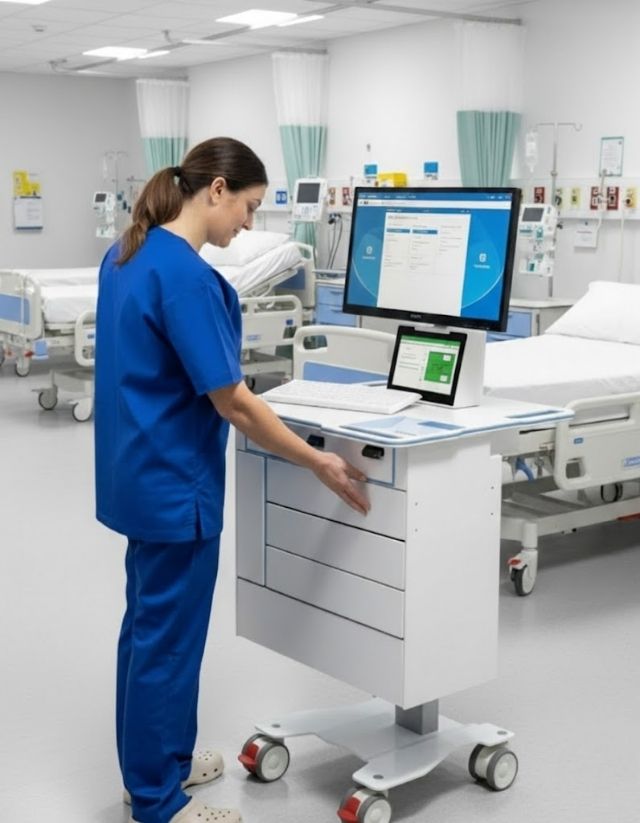
Frequently asked questions
REFERENCES
1. Berdot, S. et al. (2014). A national survey of inpatient medication systems in English NHS hospitals. BMC Health Services Research. PMC3943404.
2. NHS England. Smartcards and access controls. Available at: england.nhs.uk/long-read/smartcards-and-access-controls
3. Elliott, R. et al. (2018). Prevalence and economic burden of medication errors in the NHS in England. Policy Research Unit in Economic Evaluation of Health and Care Interventions (EEPRU).
4. Internal observation from Kinetic-ID deployment. Battery monitoring and fleet management capabilities referenced from Kinetic Service Cloud documentation.
